

# Unitree Robotics — The Intelligent Robot Leader Aiming to Replace Humans in 4D Work
60–70% is the share of the global quadruped robot market held by a single company, and that company is Unitree Robotics A startup from Hangzhou that began with one man's vision in 2013, growing to build a business network covering more than half the countries worldwide. At the CP Innovation Exposition & Symposium 2025 XiaoLi Chen (Irving Chen), a representative from Unitree, took the stage to present a vision far broader than merely selling robots — a revolution in the way humans deal with hazardous work.
This article takes an in-depth look at Unitree Robotics — from its origins in a garage to becoming a global market leader — including the “4D” vision at the company's core, its product lineup spanning quadruped robots and humanoids, the AI technology powering it all behind the scenes, and real-world use cases that are transforming industries.
🎯 Brief Summary
- Unitree holds a 60–70% share of the global quadruped robot market and has a network presence in over 50% of countries worldwide.
- The “4D” vision (Dull, Dirty, Dangerous, Dear/Difficult) aims to deploy robots in place of humans for hazardous tasks, which account for ~5% of the global labor market.
- Unitree LLM is an open-source AI model that enables robots to think and predict their own movements autonomously, rather than simply following commands.
- The company is focused on expanding partnerships in Thailand and across Asia to drive robotic technology toward genuine regional accessibility.
Who is Unitree Robotics? From a Garage to a Global Market Leader
Unitree's growth is clearly reflected through its continuously evolving product lineup that never stops developing:
In addition, all Unitree product models have received standard certification IP68 This means it offers the highest level of resistance to both dust and water, ready for real-world use in the most challenging environments—whether underground mines, chemical plants, or disaster zones.
4D Vision: Why Must Robots Replace Humans?
What is 4D?
4D is a conceptual framework describing the types of tasks that humans should no longer have to risk performing. It consists of 4 dimensions:
- Dull (Boring) — Repetitive tasks that must be performed continuously for many hours without variation, such as inspecting gas pipelines or high-voltage power lines over several kilometers.
- Dirty (Dirty / Hazardous to Health) — Work involving exposure to chemicals, dust, or environments that cause long-term physical harm, such as chemical plants or metal smelting facilities.
- Dangerous (Dangerous) — Tasks with direct risk to life, such as reconnaissance in conflict zones, firefighting in high-rise buildings, or rescue operations in collapsed mines
- Dear/Difficult (High Cost / Challenging) — Tasks requiring extremely high specialized skills or with unreasonably high operational costs, such as structural inspection of bridges at elevation
Jobs in the 4D category account for ~5% of the global labor market It may sound like a small number, but when calculated against billions of workers worldwide, it means hundreds of millions of people facing risks every day.
More concerning is the shifting trend: younger generations worldwide are increasingly avoiding hazardous work, causing critical industries such as mining, power plants, and infrastructure construction to face severe labor shortages. Nevertheless, introducing robots as replacements does not mean “stealing human jobs” — it means sending robots into environments where humans should never have been in the first place.
Product Line: Quadruped Robots vs. Humanoids
หุ่นยนต์ (Quadruped Robots)
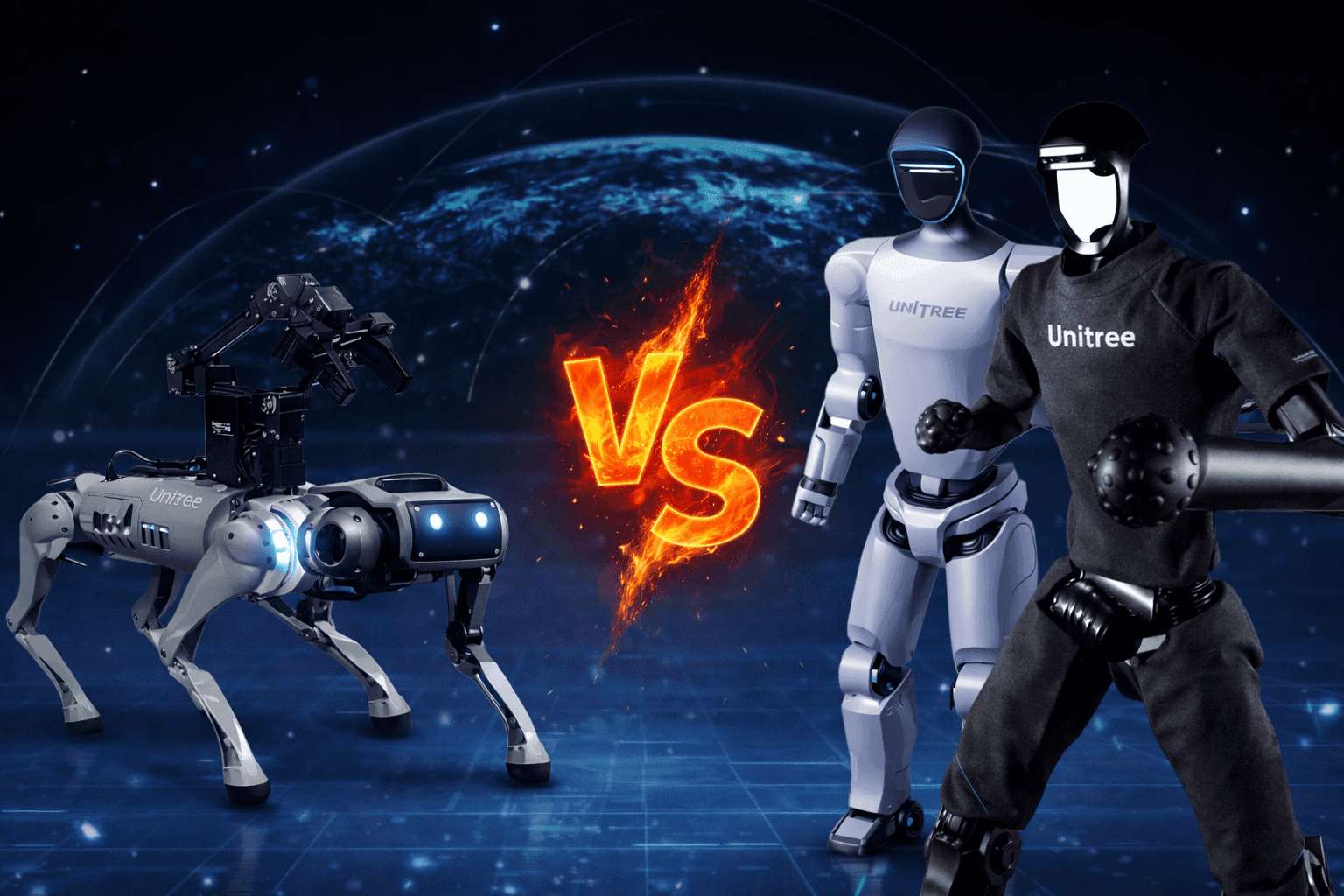
Unitree's quadruped robots are designed as true “workhorses,” capable of carrying a maximum load of 35–40 kilograms and can operate continuously for longer than 3 Hours per single charge. This capability makes it ideal for inspection tasks in underground mines that require traveling more than 12,000 meters in environments difficult for humans to access
Interestingly, Unitree is preparing to launch A2 Stellar Explorer which will elevate the industry to a new level with superior motion performance and higher payload capacity than current models
On the Humanoid side, Unitree has built a world-class reputation with H1 which claimed a landslide victory at the First World Humanoid Robot Games, sweeping as many as 7 gold medals, 3 silver medals, and 4 bronze medals In a single competition, the outstanding capabilities of H1 include:
- Ability to run and jump on rough terrain
- Automatic balance recovery when pushed or subjected to impact forces
- High-precision object grasping and manipulation
- Real-time adaptation to changing environments
Followed by G1 In 2024 and R1 in 2025, which further expanded its capabilities, giving Unitree a comprehensive Humanoid lineup covering both industrial tasks and those requiring delicate precision
The AI Technology Behind It: Unitree LLM and the Data Challenge
Hardware alone is not enough, because the heart of an intelligent robot is the “brain” behind it. Unitree addresses this with Unitree LLM a large language model that the company has released as fully open-source which is a decision that is entirely different from most competitors
What makes Unitree LLM special is that it doesn't just make robots “follow commands,” but can think and predict appropriate movements on its own When faced with situations it has never encountered before — that is the difference between a robot that is merely a machine and a robot with human-like adaptive capabilities
However, XiaoLi Chen frankly acknowledged the challenges that remain unresolved. He compared it by saying “Data is the fuel, and the model is the engine” And now the industry is facing challenges in sourcing high-quality fuel, with each data source having its own advantages and disadvantages:
- Real Data — Highly accurate, but difficult to collect and costly
- Simulation Data — Easy to generate, but still has issues Sim-to-Real Gap Making what can be done in the virtual world potentially impossible in the real world
- Synthetic Data — Fast, but still lacking realism in some dimensions
- Data from Human Demonstrations — High quality, but fragile and difficult to adapt to other environments
The ultimate goal of Unitree is therefore not just to build the largest model, but to build a model that Learns more while using less data And still operates reliably in the complex and unpredictable real world
Real-world use cases: From power plants to fire-affected areas
Drawing from its vision and developed technology, Unitree has introduced tangible use cases that are actively being realized across multiple sectors, including:
- Power Plant Inspection — Quadruped robots continuously inspect equipment and energy pipelines, reducing the need for personnel to enter high-voltage areas.
- Chemical Plant Inspection — Sensors are used to detect hazardous material leaks before humans are affected.
- Border Patrol — Reducing personnel risk in high-uncertainty areas
- Empowering People with Disabilities — Building systems that enable people with disabilities to remotely control robots for work, opening new employment opportunities
Most impressively, the concept Emergency Solutions Specifically for firefighting missions, Unitree has developed a ground robot equipped with Water Cannon (high-pressure water gun) To enter hazardous areas in place of firefighters, enabling rescue teams to control the situation from a safe distance, as XiaoLi Chen stated, “We are thinking of using ground mobile platforms to replace firefighters, by having robots equipped with high-pressure water cannons storm into buildings.” This is the clearest example of how technology can truly be used to protect the lives of those who sacrifice themselves.
Pros and Cons
| ✅ Pros | ❌ Cons |
|---|---|
| Commanding 60–70% of the global quadruped robot market, reflecting genuine confidence from real users worldwide. | The Sim-to-Real Gap remains a major obstacle, making real-world deployment significantly more complex than lab testing. |
| Unitree LLM is open-source, enabling developers and partners to build upon it without vendor lock-in. | Reliance on high-quality data for AI training remains a challenge with no complete solution yet. |
| IP68 rated and ready for real-world operation in extreme environments | The price of humanoid robots is still too high for widespread SME-level adoption |
| The product line covers both Quadruped and Humanoid robots, addressing the needs of diverse industries | Expansion into Southeast Asian markets, including Thailand, is still in its early stages |
| The 4D Vision has clear and measurable goals, not merely a marketing initiative |
Unitree Robotics has proven that having a clear vision from the outset is the key factor that allowed a startup from Hangzhou to become a global shaper of the robotics industry in less than 10 years. Its 60–70% market dominance, open-source AI development, and focus on solving 4D tasks are all part of a coherent, interconnected strategy—not technology development for technology's sake.
For organizations in Thailand and Southeast Asia operating in heavy industry, energy, or logistics sectors, this is the right time to study and pilot the adoption of Unitree in pilot projects—especially for high-risk inspection and maintenance tasks. Nevertheless, [text appears truncated]
