

# Unitree G1: The Humanoid Robot Shaking Up the Robotics Industry in 2026
Robots that can walk, run, maintain balance, and handle objects just like humans are no longer confined to Sci-Fi films — Unitree G1 From Unitree Robotics is tangible proof that Humanoid Robot technology has truly reached a remarkable milestone. At CES 2026, these robots became the standout stars, attracting more attention from investors, researchers, and technology media worldwide than anything seen in years.
This article takes you on an in-depth exploration of every dimension of the Unitree G1 — from its impressive technical specifications and the AI technology behind it, to comparisons with rivals such as Boston Dynamics Atlas and Tesla Optimus — while analyzing how humanoid robots will transform the world of work and society in the years ahead.
🎯 Brief Summary
- The Unitree G1 is a humanoid robot from Unitree Robotics, a Chinese company, designed to move in a truly human-like manner.
- Powered by an AI system utilizing Reinforcement Learning to control walking, running, and balance in real time.
- More competitively priced than rivals such as Boston Dynamics, making it well-suited for research and industrial applications.
- China is emerging as a major player in the global humanoid robot market, with Unitree Robotics leading the charge.
What is Unitree G1? Get to Know the Robot Shaking Up the Robotics Industry
Unitree Robotics Founded in 2016 in Hangzhou, China, the company started by developing quadruped robots such as Go1 and Go2, which sold well among researchers and developers worldwide, before fully entering the Humanoid Robot arena with the launch of H1, followed by G1 which is considered the most advanced and most complete model currently available. The company's reputation stands out for its ability to offer high-level technology at an accessible price point—something that competitors from the United States still find difficult to achieve.
A Humanoid Robot, or human-mimicking robot, is a robot designed with a body structure resembling that of a human—with two legs, two arms, and a head. The reason it is critically important in 2026 is that our world was built for humans: stairs, doors, tools, and workspaces are all designed for the human form. Therefore, a robot with a human-like body can operate in those environments without requiring any modification to existing infrastructure.
The Unitree G1 is designed to address three primary target groups: research and development, industrial applications, and technology demonstration, with an emphasis on balancing performance and value for money—making it stand out in a market still dominated by players commanding very high price tags.
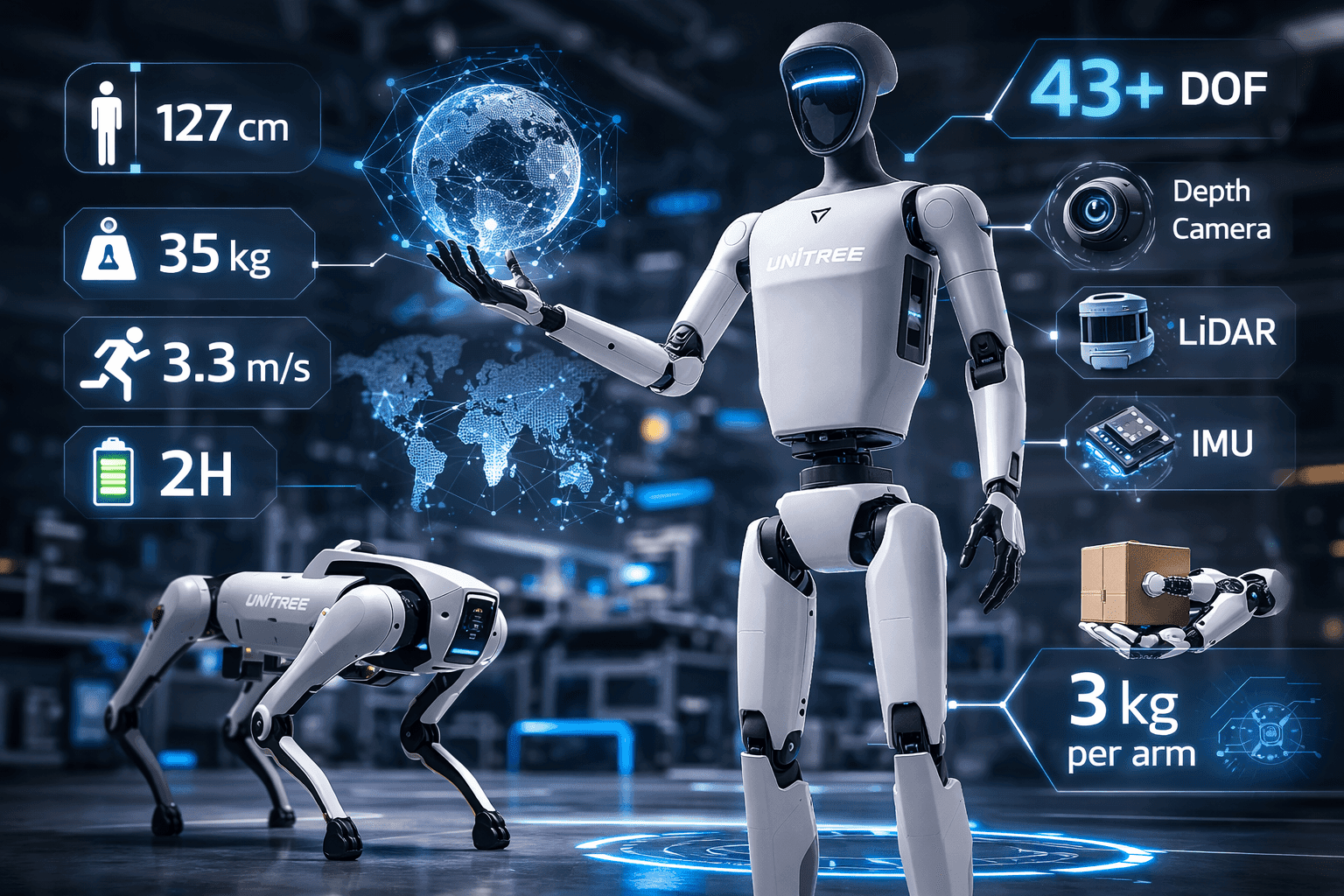
Specs and Capabilities of the Unitree G1
Technical Specifications
The figures that indicate the G1 is no ordinary robot start with its precisely designed size and weight, standing approximately 127 centimeters and weighing only 35 kilograms Significantly lighter than many competing models, making it easy to transport, install, and deploy in various environments.
The notable technical specifications are as follows:
- Degrees of Freedom (DOF): More than 43 points, covering the legs, arms, hands, and torso.
- Walking speed: Maximum approximately 2 meters per second and can run up to 3.3 meters per second
- Battery life: Continuous operation of approximately 2 Hours Depends on workload
- Payload capacity: Each arm can support a maximum load of 3 kg
- Sensor System: Features built-in Depth Camera, LiDAR, and IMU
What makes the G1 impressive is not just the numbers on paper, but the fluidity of its actual movement. This robot can walk on uneven surfaces, climb stairs, and adapt to changing environments in real-time without requiring human control at every step.
What is particularly interesting is the Self-balancing The G1 has been tested in a variety of real-world scenarios, including being pushed or disturbed while walking, and is able to recover its balance within a few hundred milliseconds. In addition, the G1's hands are designed to grasp objects of different shapes and sizes, ranging from large boxes to small objects requiring high precision.
The AI Technology Behind Unitree G1
Given its impressive specifications, the next question is: how does the AI powering the G1 work? The answer lies in the simultaneous integration of multiple technologies.
The G1's core AI system uses Reinforcement Learning to train the robot to learn movements through trial and error in a simulated environment (Simulation) before applying them to the actual body. This process enables the robot to develop maximally efficient walking gaits without step-by-step programming, which is fundamentally different from conventional methods.
The environmental sensing system of the G1 consists of:
- Computer Vision For detecting and identifying surrounding objects
- Depth Sensing To measure distance and create a 3D map of the area
- IMU (Inertial Measurement Unit) For measuring real-time body tilt and acceleration
- Proprioception Or the perception of one's own joint positions, to precisely control movement
In terms of Human-Robot Collaboration, the G1 has been developed to work safely alongside humans, featuring a force detection system at various joints to immediately halt movement upon unintentional contact with a person or object. However, this system is still under development and requires considerably more testing in real-world environments.
Unitree G1 vs Other Humanoid Robots
Now that we have a deep understanding of the G1, it's time to compare it with competitors in the market, which gives us a clear picture of where the G1 stands in the global Humanoid Robot ecosystem.
Point G1 wins clearly is the matter of price and availability. With a price of approximately 16,000 USD Making it accessible to universities, research institutions, and startups seeking an AI development platform. While the Boston Dynamics Atlas offers more impressive acrobatic performance, its price and accessibility remain major barriers.
Nevertheless, areas where the G1 still needs further development include its capability for sustained heavy-duty operation and durability in harsh environments — advantages that Boston Dynamics holds through years of accumulated development experience.
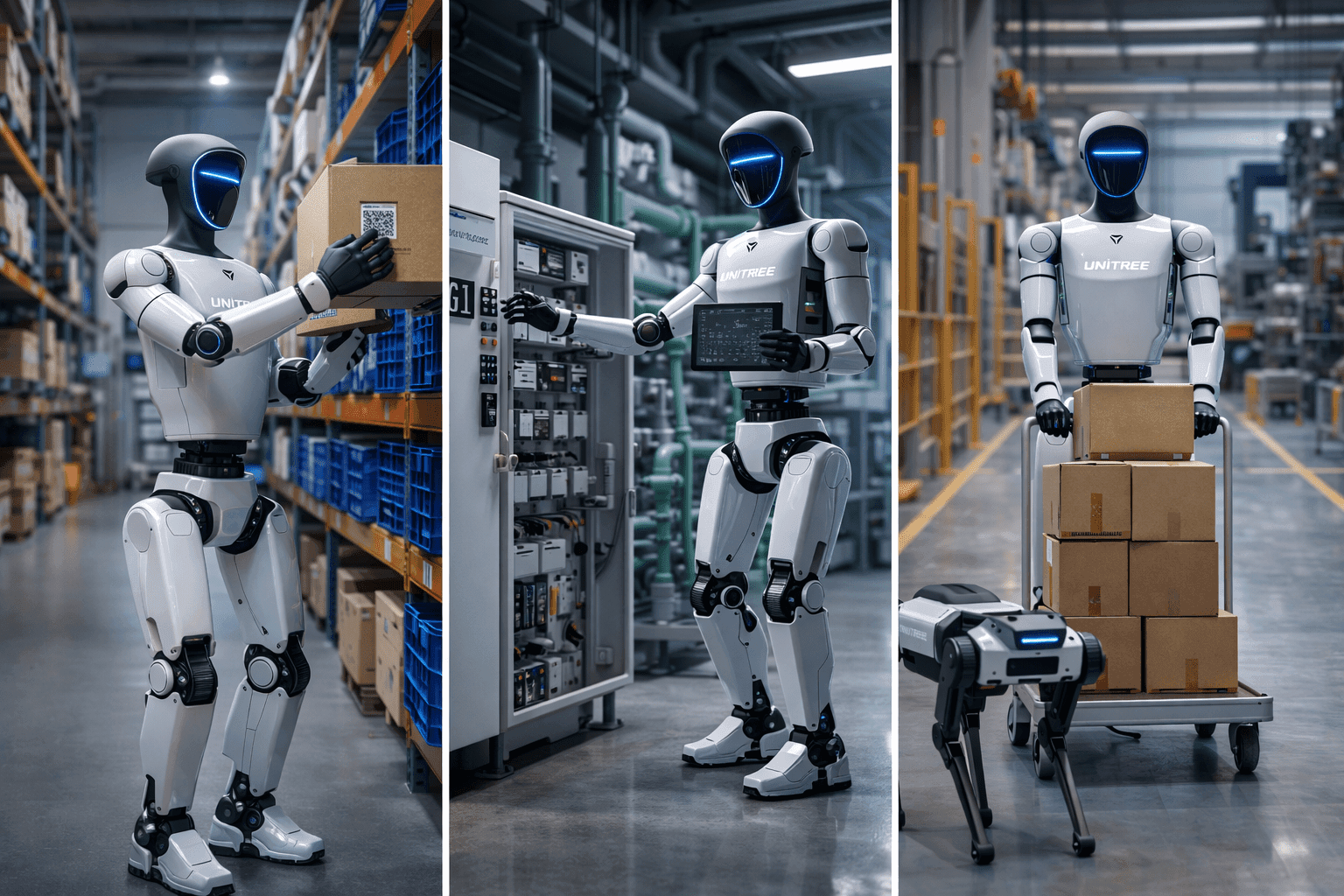
Real-World Applications of the Unitree G1
Based on the comparative data presented, it is clear that the G1 is positioned as a practical, deployable platform — not merely a showpiece. Currently, numerous universities and research institutions in China, the United States, and Europe have adopted the G1 as a development base for AI in the areas of locomotion, environmental perception, and human interaction, as its accessible price point enables budget-constrained labs to operate a robot of this caliber in real-world settings.
In the industrial and logistics sectors, the G1 has the potential to perform the following tasks:
- Product Picking and Sorting In Warehouses Designed for Humans
- Inspection and Maintenance Equipment in Hazardous Areas
- Material Transport Between Stations in a Factory
- Operation in narrow or complex areas that wheeled robots or robotic arms cannot reach
Notably, during the 2026 Chinese New Year, robots from Unitree were featured in the Spring Festival Gala, broadcast live to hundreds of millions of viewers worldwide, performing kung fu moves and complex movements in an impressive manner. This was a highly impactful demonstration in terms of building public awareness. In the long term, the potential for home and public space applications remains a goal to be further developed, particularly in areas of safety and interaction with general users who have no technical background.
The Future of Humanoid Robots
The success of the G1 in the market is no coincidence, but part of a major trend unfolding worldwide. The global Humanoid Robot market in 2026 is valued at approximately USD 1.5 billion and is expected to grow to 38 billion dollars by 2035, according to estimates from multiple analyst firms. These figures reflect the world's growing and serious confidence in this technology.
China's role in the robotics competition with the United States is intensifying by the day. Unitree Robotics is just one of dozens of Chinese companies developing humanoid robots at full capacity, backed by Chinese government policies that aim to make the country a global leader in robotics by 2030. China's advantages lie in lower production costs, a robust supply chain, and an enormous domestic market.
Furthermore, the impact on the labor market is an issue that must be addressed directly. Humanoid robots like the G1 have the potential to replace repetitive manual labor in factories and warehouses, but at the same time will create new jobs in AI system development, maintenance, and control. What society must prepare for is reskilling the workforce and establishing clear policy frameworks regarding the safety and ethics of deploying robots in public spaces.
Pros and Cons
| ✅ Pros | ❌ Cons |
|---|---|
| An accessible price point of approximately $16,000 USD compared to competitors in the same class. | Battery life of only ~2 hours is still insufficient for continuous operation tasks. |
| With up to 43+ DOF, it achieves the most human-like range of motion available at this price level. | Durability in harsh environments does not yet match that of the Boston Dynamics Atlas. |
| Lightweight at only 35 kg, easy to install and transport | The Human-Robot Collaboration system is still under development |
| Already available for commercial sale, no need to wait | Software and ecosystem for developers are not yet as complete as Tesla or Boston Dynamics |
| The AI system using Reinforcement Learning enables good adaptation to new environments |
The Unitree G1 is not just another robot on the market — it is a clear signal that Humanoid Robots are entering an era of genuine commercial viability. Its most outstanding strength is delivering high-level performance at an accessible price point, a formula that competitors have yet to match at the same level. As AI technologies in Reinforcement Learning and Motion Control continue to advance rapidly, the capabilities of the G1 will progress even further in the years ahead.
For anyone looking to enter the Humanoid Robot industry today, the G1 is highly suitable for researchers, AI developers, and companies seeking a testing platform at a reasonable price. However, for full-scale deployment in real industrial environments, it may be worth waiting another 1–2 years to see advancements in battery life and durability. This competitive arena is heating up every day, and the ultimate winner will be the one who can make robots work alongside humans safely, reliably, and most cost-effectively.
