
# Unitree G1 — The Humanoid Agent Robot of the Future
The Humanoid robot market is growing exponentially, with Goldman Sachs forecasting that by 2035, the market value will reach 38 billion USD — and Unitree Robotics is positioning itself right at the center of this wave, with the launch of Unitree G1 A robot that does not merely walk or lift objects, but comes with a vision far greater than that — to be an “AI Avatar in the Real World”
This article will give you a comprehensive introduction to the Unitree G1 — from the concepts behind its design, the AI and Perception systems that make it smarter than ordinary robots, to real-world use cases and the groups who will benefit most from it, as well as a comparison with market competitors to help you make an informed decision.
🎯 Brief Summary
- The Unitree G1 is a Humanoid Agent designed to be an “AI Avatar in Real World” at a price point more accessible than global competitors.
- Compact design, only 127 cm. Foldable and gymnastic-level flexible movement
- Supports AI Imitation Learning and Reinforcement Learning — teaches new skills just like training a real human
- System 3D LiDAR + Force Control Enabling 360-degree environmental awareness and precise handling of delicate objects
What is Unitree G1 and Why Does It Matter in 2026
When discussing Humanoid robots over the past 2-3 years, the most frequently mentioned names are Boston Dynamics, Tesla Optimus, and Figure AI — all of which carry high price tags and target large-scale industries. However, Unitree Robotics has chosen a different path by building a “Foundation Humanoid Agent” that researchers, developers, and educational institutions can genuinely access
Unitree G1 is not just a bipedal robot, but it is Platform for AI Development That is open for research teams around the world to freely experiment, customize, and teach new skills. This is what sets it apart from previous generation Humanoid robots that are often locked within closed systems by their manufacturers.
Interestingly, the name "G1" reflects the concept of Genesis — a new era where robots are no longer specialized tools, but have become "agents" that learn and adapt like humans — and that is the vision Unitree is proving to be real in 2026.
Agility-Focused Design: Why "G1"
Compact and Foldable Design
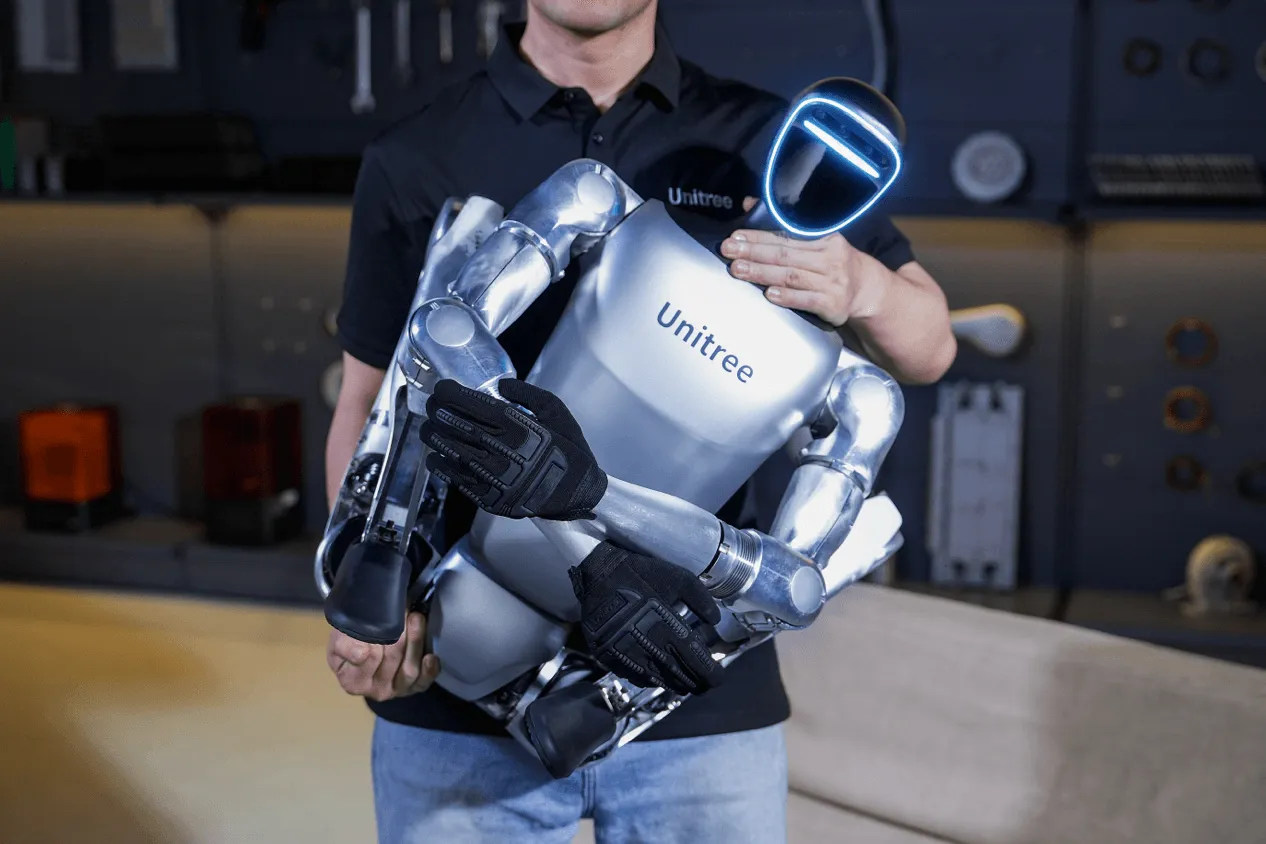
Height 127 cm. And its well-controlled weight make the G1 a “truly portable” Humanoid — not just marketing. Its Foldable Body allows it to be transported in a bag or an ordinary car, without requiring a special truck like most large robots.
Compared to the Boston Dynamics Atlas, which stands up to 150 cm tall and is considerably heavier, or the Tesla Optimus, which is designed specifically for factory use, the G1 is a more flexible option for a wide variety of environments.
Supremely Flexible Joints — Unrivaled Flexibility
What excites engineers and researchers the most is Degrees of Freedom (DOF) Unusually high for a robot in this price range, the G1 can perform complex movements that older robots cannot, such as:
- Able to get up from the ground on its own Even when fallen in various positions
- Twisting the body and extending the arms At angles that naturally mimic human movement
- Perform basic gymnastics poses Such as a full-range forward bend or a squat
- Walk on uneven surfaces Without losing balance
In addition to flexible hardware, the G1 also supports a mechanism for AI Imitation Learning that allows developers to demonstrate postures or skills, then have the robot learn and replicate them, combined with Reinforcement Learning to continuously improve accuracy. This means research teams do not need to code every movement from scratch — simply “show it” and the G1 will learn on its own.
Below is a specification comparison table between the G1 and competing Humanoid robots on the market:
AI System and Environmental Perception
Beyond the hardware agility mentioned above, what truly makes the G1 intelligent is the Perception and AI system operating in the background — the core that enables this robot to “feel” and “think” at an impressively capable level.
The core technologies in the Unitree G1's Perception system include:
- 3D LiDAR (360°) — Scans the surrounding environment in real-time, creating 3D maps and detecting obstacles even in low-light conditions
- Depth Camera — Works in conjunction with LiDAR to analyze the distance and shape of objects with millimeter-level precision
- Force Control Dexterity — A force control system for the hand and fingers, enabling the gripping of raw eggs or glasses of water without crushing or dropping them
- Dynamic Balance System — A real-time adaptive balance system that maintains stability even when pushed or stepped on slippery surfaces
- Real-time Mapping — Continuously builds and updates environmental maps, suitable for areas that are subject to change
However, what is most fascinating is how these systems work together, not separately. LiDAR says “there is a table 80 cm ahead,” the Depth Camera says “there is a glass of water on the table,” and Force Control enables the hand to pick up that glass without spilling it — all of this happens simultaneously in real time.
Who is the Unitree G1 for? Real-World Use Cases
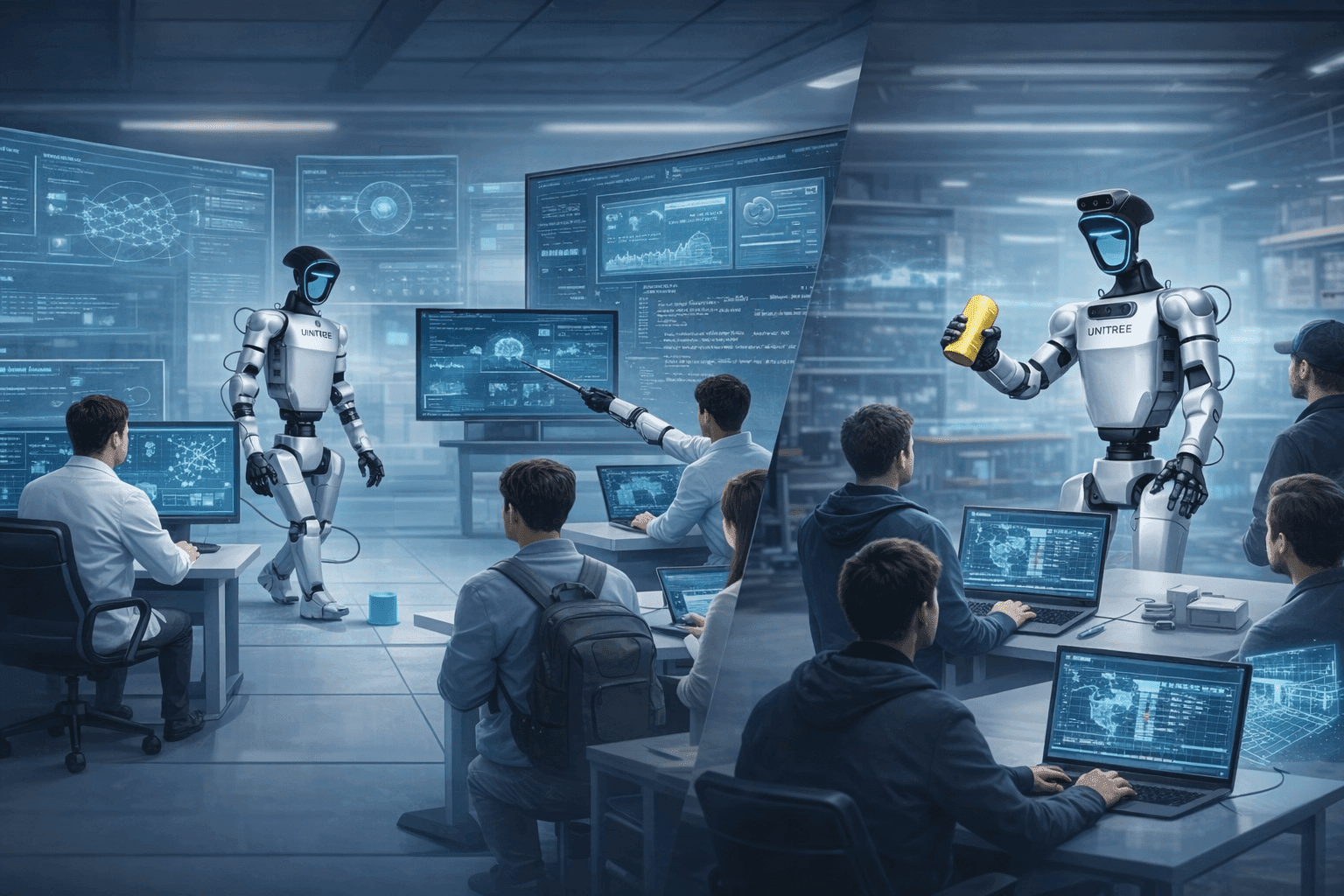
Now that we understand both the hardware and AI system, the key question is: who is the G1 suited for, and in what context? The answer is clearer than you might think, because Unitree designed it for 3 Main Groups Specifically
- AI/Robotics Researchers and Developers — G1 is a platform that allows free experimentation with new Algorithms, whether it be developing Locomotion Policy, Manipulation Tasks, or Multi-modal AI that integrates Vision with Language Models.
- Educational Institutions and Universities — A more accessible price point compared to competitors allows Robotics or AI Engineering departments to actually purchase it as a teaching tool, not just watch it in videos.
- Industrial Sectors Requiring Low-Cost Humanoid Agents — Factories, warehouses, or environments requiring Flexible Automation without investing in expensive specialized production lines.
What is interesting is that the Use Cases currently being tested in practice cover both Assembly and Quality Control in factories, assistance in hazardous environments such as disaster areas, all the way to serving as a Research Platform for developing Embodied AI, which is becoming a key trend in the AI industry in 2026
Pros and Cons
| ✅ Pros | ❌ Cons |
|---|---|
| Estimated Price $16,000 USD Significantly more affordable than competitors in the same class | Still in the development phase; the stability of the Software Stack may require further tuning. |
| Highly compact design at 127 cm with foldable structure, offering greater portability than typical Humanoid robots. | The smaller size (127 cm) may limit certain applications requiring greater strength or height. |
| Over 43 DOF supports complex movements at a gymnastics-level range of motion. | Still lacks a diverse Third-party Application ecosystem compared to platforms that have been on the market for longer. |
| Supports AI Imitation Learning + Reinforcement Learning, open to developers | Battery Life and usage time per charge remain limitations commonly found in general Humanoid robots |
| 3D LiDAR + Depth Camera + Force Control system fully equipped at this price level | Requires a team with knowledge in Robotics and AI to operate at full efficiency |
| Unitree has a strong developer community and SDK documentation |
Unitree G1 isn't just launching a new robot — it's redefining “who can access a Humanoid Robot” through a combination of compact foldable design, high-degree joint flexibility, comprehensive Perception systems, and AI Learning that is open to developers. All of this comes at a price point that makes the G1 the most compelling option in the Humanoid market in 2026.
For Researchers, AI development teams, and academic institutions The G1 is the most cost-effective platform for experimenting with and developing Embodied AI without waiting for Enterprise-grade robot prices to drop. That said, if you are an organization looking to Deploy immediately in an actual production line, you may need to wait a while longer to assess the stability of the Software Ecosystem. However, for anyone who wants to be at the forefront of Humanoid AI development — the G1 is the best starting point available right now.
