
$13,500 for a robot that can walk, lift objects, and learn like a human

— This would have sounded like an impossible price a few years ago, but Unitree Robotics is proving this to be a reality in 2024 with the launch of C an AI-powered humanoid robot, considered the cheapest option in its class on the global market, while competitors like Boston Dynamics or Figure AI remain at price points unattainable for general users.
This article will take you deep into every dimension of Unitree G1, from full specs and underlying technology to a comparison between models. Standard G1 and G1 EDU specifically designed for researchers, along with an analysis of pros, cons, and suitability for purchase, to help you make an informed decision.
🎯 Brief Summary
- Consumer-grade humanoid robot starting at just $13,500 — The cheapest in its class on the global market
- 2 models available: G1 (23 DoF) for general users and demonstrations, and G1 EDU (up to 43 DoF) for researchers and developers
- Uses technology Force-Position Hybrid Control together with UnifoLM (Unified Robot Large Model) for precise and intelligent movement
- The EDU model fully supports Secondary Development, with NVIDIA Jetson Orin and a warranty of up to 18 months
What is Unitree G1? An overview of the new-era humanoid robot
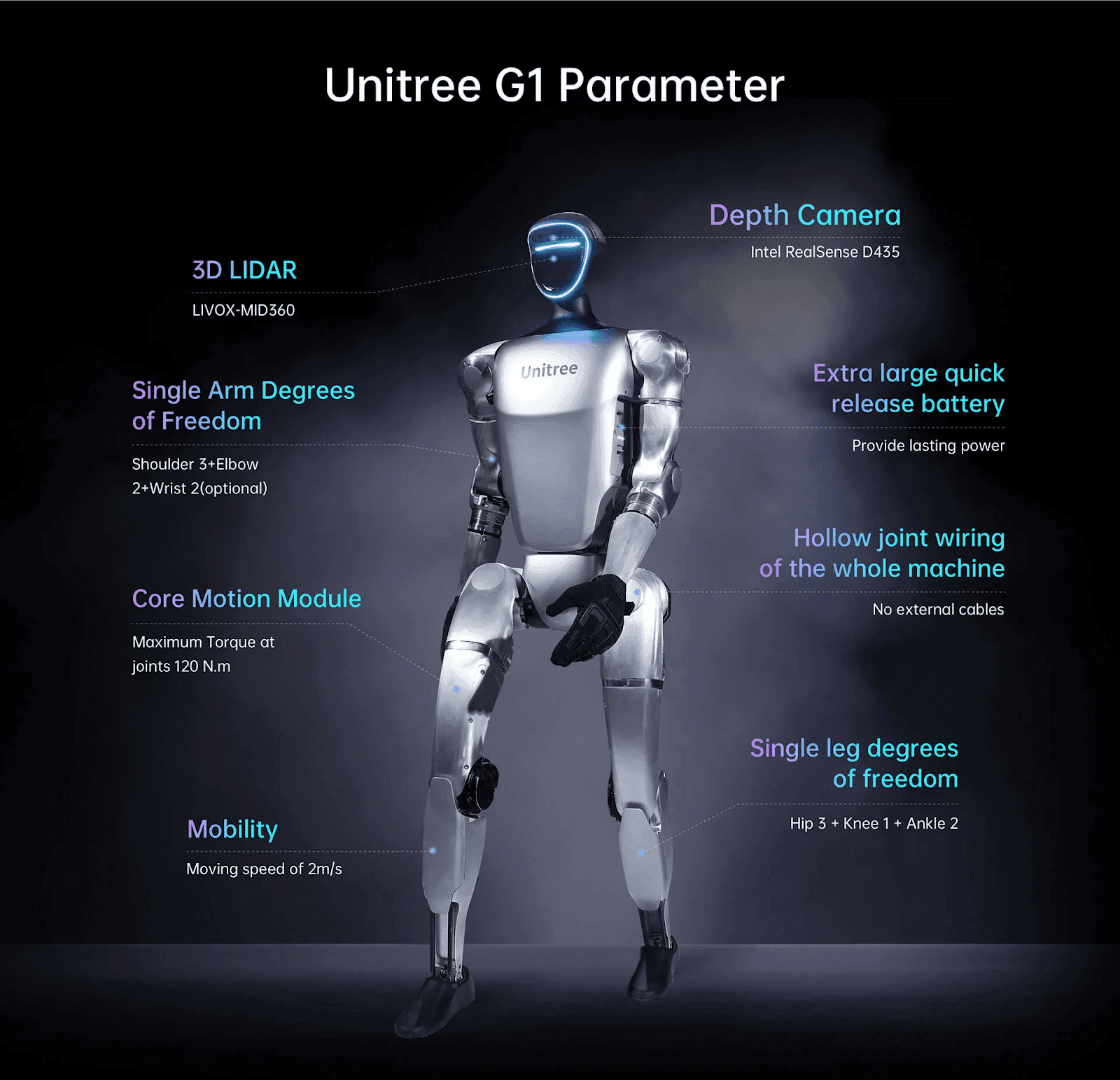
Unitree Robotics, a Chinese company known for its robot dogs Go1 and B1, has fully entered the humanoid robot field with G1. Unitree's clear stance is to make humanoid robots widely accessible, not just for large organizations or national research, but also for independent developers, universities, and robotics enthusiasts worldwide.
The core technology of G1 is the system of Force-Position Hybrid Control which allows the robot to perceive and respond to forces acting on its body in real-time. The result is movement that “feels” what it touches, not just following traditional Position Control commands, enabling it to grasp delicate objects without damage or maintain balance when pushed.
Interestingly, Unitree has developed UnifoLM (Unified Robot Large Model) which is a large AI Model specifically designed for robot control. Similar to how Large Language Models changed the world of NLP, UnifoLM aims to set a new standard for Robot Intelligence by allowing robots to learn and adapt to new situations more flexibly than traditional Rule-based programming.
Specifications and Data: G1 vs G1 EDU
Dimensions and Weight
Both models have the same external structure, with dimensions when standing upright of 1,320 × 450 × 200 mm. and when folded, it reduces to 690 × 450 × 300 mm. which is convenient for transport and storage. The weight including the battery is approximately 35 kg. for the standard G1 model, while the G1 EDU may be slightly heavier depending on the selected Option.
Joint and Movement System
This is where the two models differ significantly. The standard G1 comes with 23 Degrees of Freedom (DoF) while the G1 EDU can be expanded up to 43 DoF through various optional Options. The DoF distribution details are as follows:
- Each leg: 6 DoF (total 12 DoF)
- Waist: 1 DoF (G1) or up to 3 DoF (G1 EDU — an additional 2 DoF can be added)
- Each arm: 5 DoF (total 10 DoF)
- Each hand (EDU only): 7 DoF from Dex3-1 hand + Optional 2 additional DoF at the wrist
The Joint Movement Space is exceptionally wide. For example, the Hip Joint can rotate up to ±154° in Pitch and ±158° in Yaw. The Knee Joint can bend from 0 to 165° which is close to the actual range of human movement.
Motor and Joint System
Both models use motors of type Low Inertia High-speed Internal Rotor PMSM (Permanent Magnet Synchronous Motor) which provides better response speed and heat dissipation than External Rotor motors often found in previous robot models. The bearing system uses Industrial Grade Crossed Roller Bearings which are highly precise and can bear heavy loads well.
Additionally, there are interesting engineering highlights, including:
- Dual Encoder in every joint for precise position sensing.
- Full Joint Hollow Electrical Routing — Wiring through the center of the joint reduces the risk of tangled wires.
- Local Air Cooling For motor cooling
The torque difference between the two models is also important: The standard G1's Knee Joint provides a maximum torque of 90 N.m while the G1 EDU provides up to 120 N.m which directly affects its load-bearing capacity and walking stability.
Computer and Sensor Systems
Both models come with 8-core High-performance CPU as standard, along with a comprehensive Sensing Suite comprising a Depth Camera, 3D LiDAR, 4 Microphone Array, and 5W Speaker, supporting WiFi 6 and Bluetooth 5.2 for wireless communication.
What the G1 EDU adds is NVIDIA Jetson Orin a High Computing Power module as standard for AI Inference tasks in robots and autonomous vehicles, which opens the door for developers to run complex Models directly on the robot.
Both models use a 9,000 mAh Smart Battery 13 String Lithium type, charged with a 54V 5A Charger, and features a Quick Release system for quick replacement. The operating time per charge is approximately 2 hours which is sufficient for demonstrations or lab experiments, but may require planning for tasks requiring longer continuous use.
Complete G1 vs G1 EDU Comparison Table
Based on all the specifications mentioned, here is a Side-by-Side comparison for the clearest picture.
Dex3-1 Hand: Three-Fingered Dexterous Hand

From the comprehensive specifications of the robot, the Dex3-1 Hand is considered the most interesting option for G1 EDU, especially this 3-fingered hand has a structure of 7 Active Degrees of Freedom divided into 3 DoF for the thumb, 2 DoF for the index finger, and 2 DoF for the middle finger. The 3-finger design, instead of 5 fingers, is not a cost-saving measure but an engineering choice that provides greater strength and reliability.
A prominent feature of Dex3-1 is its integration with the robot's Force-Position Hybrid Control, allowing the hand to perceive forces acting on each finger in Real-time and automatically adjust gripping force. It also supports the installation of Tactile Sensor Array as an optional add-on, which will enhance the ability to perceive surfaces and pressure with greater detail. It is suitable for Haptics research or high-precision object manipulation tasks.
Usage and Target Audience
The difference between the two models clearly reflects distinct user groups. The standard G1 is suitable for
- Demonstrations and Showcases at Events, exhibitions, or showrooms
- Light-duty tasks that do not require complex object manipulation
- Those who want to experiment with humanoid robots for the first time
- Companies that want to use robots as an Interface or Mascot
Conversely, the G1 EDU is designed for groups that want to “get hands-on” with the system, whether it's universities conducting Locomotion research, AI teams needing a Platform for testing Models, or Robotics Startups looking for ready-to-use Hardware at an accessible price.
However, what needs to be aware of before purchasing is the warning from Unitree itself, stating that a safe distance should always be maintained between the robot and humans due to its complex structure and very high power. Additionally, there is a warning for individual buyers that the humanoid robot industry is still in its “early stages of exploration” and limitations should be thoroughly studied before making a purchase.
Price and Purchase Conditions
Price is one of G1's strongest selling points, but there are details to understand first.
Price $13,500, not including import taxes and international shipping costs For buyers in Thailand or the SEA region, additional costs may need to be added. The G1 EDU has no set price and requires direct contact with the sales team, indicating that the price may vary depending on the selected Configuration.
For individual buyers, Unitree explicitly recommends studying the limitations of humanoid robots before making a decision and strictly prohibits modification for harmful purposes. The 8-month warranty period for the standard model is considered quite short compared to the 18 months for the EDU model, which is another factor to consider in the decision-making process.
Pros and Cons
| ✅ Pros | ❌ Cons |
|---|---|
| The starting price of $13,500 is considered the lowest entry point in this level of the humanoid robot market. | Battery life of only ~2 hours per charge limits continuous use. |
| Force-Position Hybrid Control provides precise movements and good responsiveness to the environment. | The standard G1 is only guaranteed for 8 months, which is quite short for a device at this price. |
| G1 EDU fully supports Secondary Development, suitable for AI research and development. | The standard G1 does not support Secondary Development, forcing developers to choose only the EDU. |
| Very wide joint range of motion (Knee 0–165°, Hip ±154°), close to real human movement. | The price of $13,500 does not include import taxes and shipping costs; the actual cost may be much higher. |
| Features Dual Encoder and Full Joint Hollow Electrical Routing, which are high-level engineering standards. | The standard G1 does not come with hands; Dex3-1 must be purchased additionally through the EDU model. |
| G1 EDU comes with NVIDIA Jetson Orin, supporting direct AI Inference on the robot. | The industry is still in its early stages; some Features are still under development and not yet available. |
| Both models support Upgraded Intelligent OTA, allowing continuous capability updates. | Requires a fair amount of Robotics knowledge for safe and efficient use. |
Unitree G1 is a significant step proving that humanoid robots are no longer just a dream of research labs. With a starting price of $13,500, Force-Position Hybrid Control and UnifoLM technology, and comprehensive specifications including a Sensor Suite and Computing Power, it is a Platform that allows both researchers and enthusiasts to truly begin exploring the world of Humanoid Robotics.
Regarding the question “Who should buy G1?” — If you are a university, research team, or Robotics Startup that needs a Hardware Platform with Secondary Development G1 EDU is the clear answer. Although the price is higher, the 18-month warranty and NVIDIA Jetson Orin are much more worthwhile. For individual buyers or organizations looking to use it for demonstrations, the standard G1 might be sufficient, but the total cost after adding taxes and shipping should be checked before deciding. And most importantly — it should be understood that
ข้อควรรู้เพิ่มเติม ถ้าเป้าหมายของคุณคือการเรียนรู้และทดลองมากกว่าการใช้งานเต็มรูปแบบ ยังมีหุ่นเดินสองขาที่ราคาต่ำกว่านี้มาก อย่าง หุ่นยนต์เป็ด Microduck ซึ่งราคาตั้งต้นราว 399 ดอลลาร์ และเปิดชุดฝึก AI ทั้งหมดให้ดาวน์โหลดไปศึกษาได้
