
Drones registered in Thailand are about to face the biggest regulatory change in 6 years, as the NBTC (National Broadcasting and Telecommunications Commission) opens public consultation on 4 new draft regulations at once — covering everything from registration and radar systems to satellite-based flight — with comments due by July 3, 2026.
This article breaks down who each draft affects — whether you're a hobbyist pilot flying photography drones on weekends, an agricultural operator wanting to fly BVLOS across fields, or an equipment importer who needs legal clarity before ordering a new batch of stock.

🎯 Brief Summary
- The new rules legally allow BVLOS flight via mobile networks and satellite for the first time — but a separate CAAT flight permit is still required.
- Anyone who hasn't yet registered their drone's radio communication equipment has 90 days after the regulation takes effect — after that, it's considered illegal.
- Importers and sellers are affected the most, as they must pass new certification standards for both radar and satellite equipment before offering products for sale.
The NBTC and Drone Regulation: Why New Rules Are Needed
NBTC vs. CAAT — What's the Difference?
A single drone falls under the oversight of two agencies at the same time, which often confuses everyday users. Each agency's responsibilities are clearly divided as follows:
Complications arise when these two dimensions overlap. A clear example is flying beyond visual line of sight, or BVLOS (Beyond Visual Line of Sight) Even if the spectrum used already meets NBTC standards, operators still need a separate CAAT permit before actually flying the drone — passing one checkpoint doesn't mean passing every checkpoint.
Why the 2020 Regulations Are No Longer Enough
The regulations issued in 2020 were designed mainly for short-range photography drones, which reflected the usage patterns of that era well. But the drone industry landscape has changed dramatically in recent years. Today, drones are used in agriculture for spraying and surveying farmland, for surveying terrain in remote areas, and in rescue missions to help disaster victims.
These expanded uses bring entirely more complex spectrum requirements than before — whether it's connecting via mobile networks for remote control, using satellite signals for BVLOS missions, or advanced radar systems for automatic obstacle avoidance. These are all technologies that the 2020 regulations never covered. This has left operators and importers facing ongoing legal uncertainty. The 4 new draft regulations that the NBTC has opened for public comment until July 3, 2026 are a direct attempt to close these gaps.
A Deep Dive into the 4 Draft Regulations: Who Does Each One Affect?
Draft 1 — General Drone Spectrum (Affects Every User)
This draft is the core of the reform, as it covers every group of drone users. Its main content is making the spectrum that drones on the market already use more legally compliant, andallowing BVLOS (Beyond Visual Line of Sight) flight via mobile networks and satellite for the first time under Thai law. However, BVLOS flight still requires a separate CAAT permit. There's also a major overhaul of the process for registering a drone's radio communication equipment — meaning registering the frequency transceiver equipment built into the drone specifically with the NBTC, not registering the drone itself with CAAT as many people assume. See the comparison table below.
As for Remote ID systems, which have drones broadcast identification signals while flying, this is not yet mandatory but is likely to become required in the future. Anyone about to buy a new drone should choose a model that supports Remote ID in advance.
Draft 2 — Radar and Obstacle-Avoidance Standards
The old rule, issued in 2021, only supported one type of radar technology, leaving newer drones with automatic obstacle-avoidance systems — such as the DJI Mavic 3 or new agricultural drones with built-in obstacle avoidance — in a legal gray area all along. This draft solves the problem by adding radar categories to cover the technology currently used in the global market. Importers and sellers of drones with this system must obtain NBTC certification before offering them for sale. Importing and selling without going through this process is illegal.
Draft 3 — Satellite Equipment Standards for Drones (Entirely New)
This is an entirely new regulation with no prior precedent in Thai law, created to support the satellite-based BVLOS flight that Draft 1 opens the door to. Previously, Thailand had no central standard for satellite equipment on drones at all, leaving operators wanting to use satellite-connected drones unsure whether their equipment was legal. This draft requires satellite equipment on drones to meet the same international standards used in Europe and the United States. Operators planning satellite-based BVLOS flights must check whether their equipment already meets this standard. If it doesn't meet the standard, it cannot be imported or used in Thailand.
Draft 4 — Updated List of Generally Permitted Frequencies
This final draft acts as the glue that ties the whole set of regulations together, officially adding drones and drone radar systems to the list of generally permitted frequencies, which helpsreduce confusion for importers and sellerswho previously had to interpret the rules themselves to figure out which equipment qualified for permission.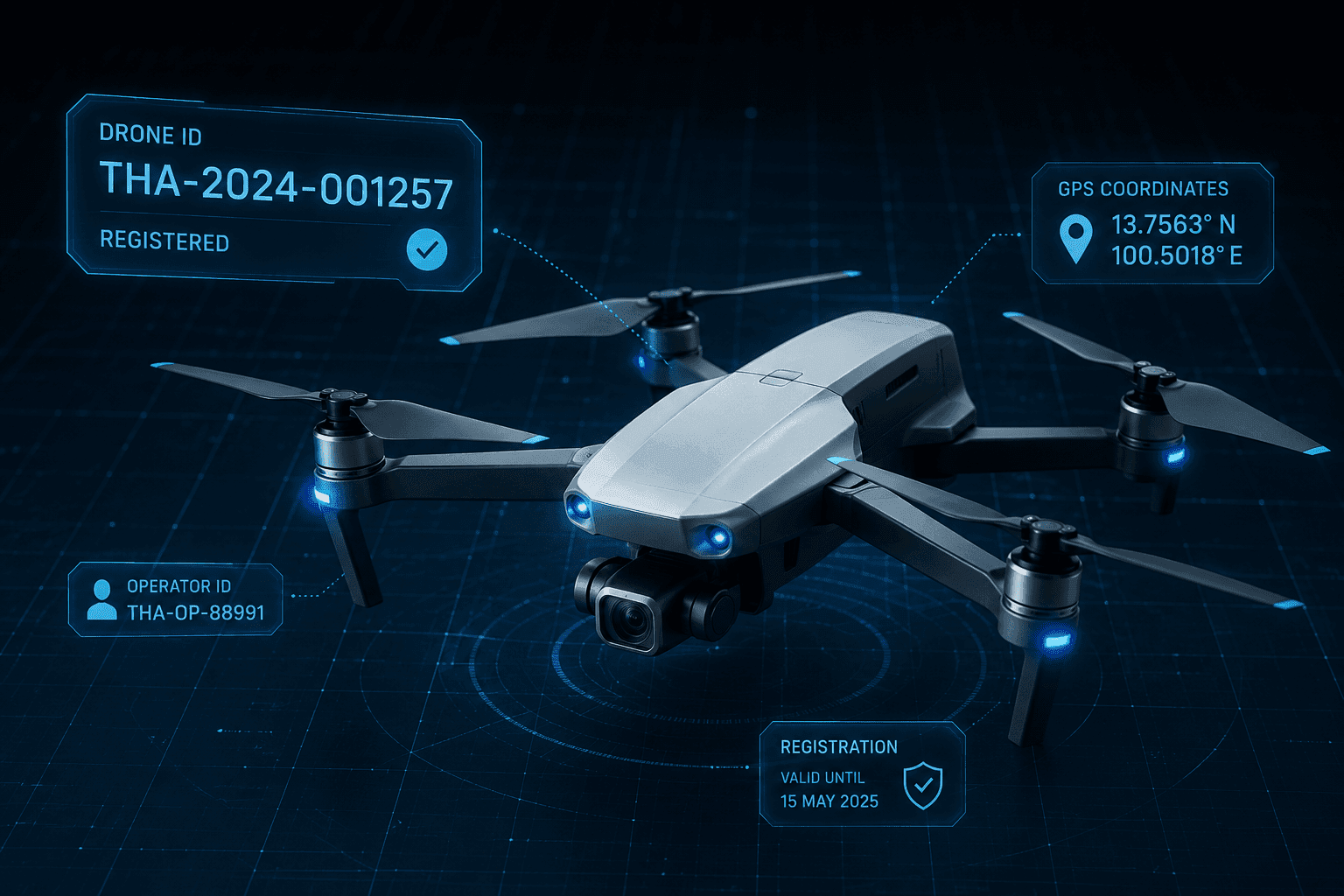
Impact by User Group: What You Need to Do
General Drone Users / Hobbyist Pilots
The first thing to do is check the registration status of your drone's radio communication equipment with the NBTC, which is separate from registering the drone with CAAT. If you've already registered, no further action is needed, because itcarries over automatically. But if you've never registered, you have 90 days after the regulation takes effect to complete the process correctly. What's changed is the timeframe — there's no longer a 30-day grace period. Anyone buying a new drone must register it immediately upon taking possession, and if a drone is transferred to someone else, the old registration must be canceled and a new one made immediately as well. Also, if you're about to buy a new drone, you should consider choosing a model that supports Remote ID in advance — because even though it's not mandatory now, there's a clear trend toward it becoming a mandatory requirement in the future.
Operators and Commercial Pilots (BVLOS)
This group faces both impact and opportunity at once. The draft regulations open the door to BVLOS flight via mobile signal and satellite for the first time under Thai law. However, getting NBTC approval for spectrum use alone isn't enough — a separate permit is still required from CAAT for actual flight operations. Anyone planning to use satellite connectivity for BVLOS flight must check that the drone's satellite equipment meets the international standards set out in Draft 3.
Drone Importers and Sellers
This group clearly faces a heavier burden — but on the flip side, Draft 4's updated list of generally permitted frequencies will help reduce confusion when importing products, making it clearer than before which products are legal in Thailand.
| ✅ Pros | ❌ Cons |
|---|---|
| Opens new business opportunities for BVLOS operators who had been stuck in a legal gray area for more than 6 years. | Retailers must bear the burden of registering on behalf of customers before delivery, adding steps and operating costs. |
| Significantly reduces confusion for importers with a much clearer list of permitted frequencies. | The non-refundable 200-baht fee, charged in every case, could add up for anyone who transfers drones frequently. |
| The new satellite equipment standard brings Thailand in line with international standards, boosting its credibility at the regional level. |
FAQ – Frequently Asked Questions
❓ What Frequencies Do Drones Use?
Most drones on the market primarily use 2.4 GHz and 5.8 GHz — the same bands as Wi-Fi. The NBTC's new rules add 72 MHz for older drones and RC transmitters, 433 MHz for telemetry systems, and 920 MHz for data transmission and position reporting. In addition, obstacle-avoidance radar systems use higher frequencies in the 24 GHz, 57–64 GHz, and 76–77 GHz bands.
❓ If I've Already Bought and Registered My Drone, Do I Need to Do Anything Else?
No further action is needed. Your existing registration remains valid automatically. You should just double-check that the information on file is still accurate and up to date.
❓ What Is Remote ID, and Is It Mandatory Yet?
Remote ID is a system that has drones broadcast identification and location signals while flying — like a license plate visible from the air. It's not mandatory yet, but is likely to become required in the near future, so you should choose a drone that supports it in advance when buying a new one.
❓ What Do Operators Wanting to Fly BVLOS via Satellite Need to Do?
Two things must be done together: use satellite equipment that meets the standards under Draft 3, and separately obtain BVLOS flight approval from CAAT. Meeting NBTC standards alone is not sufficient for this type of flight.
These 4 new regulations aren't just a technical update — they reshape the legal foundation that drones in Thailand will operate under for years to come. For general users, the immediate action is to check your drone's registration status. For operators and importers, the 90 days after the regulation takes effect is a window that must be used wisely to adjust processes to meet the new standards.
More importantly, all 4 draft regulations remain open for public comment until July 3, 2026. Submit feedback to [email protected] for Drafts 1 and 4, and [email protected] for Drafts 2 and 3. For further inquiries, call 02-670-8888.
