
CAAT Announcement No. 15 (2026)
The CAAT has relaxed some measures but still maintains no-fly zones for security purposes.
It is effective from February 6, 2026, until further notice or changes are announced.
No-Fly Zones according to Announcement No. 15.
The operation or release of unmanned aircraft (drones) is prohibited in areas that may affect the national security.
Areas with deployment/ground operations (district level) in 7 provinces:
Note: Announcement No. 15 is a relaxation of the previous announcement, while still maintaining the specified security areas.
Areas specifically prohibited by energy and security agencies:
- Phetchaburi Province (Ban Laem District).
- Samut Songkhram Province (Mueang Samut Songkhram District).
- Samut Sakhon Province (Mueang Samut Sakhon District).
No-fly zone within a radius of 9 km (5 nautical miles) around designated airports.
- 1. Chiang Mai.
- 2. Phitsanulok.
- 3. Udon Thani.
- 4. Nam Phong.
- 5. Taklee.
- 6. Ubon Ratchathani.
- 7. Nakhon Ratchasima (Korat).
- 8. Watthana Nakhon.
- 9. Kamphaeng Saen.
- 10. Don Mueang.
- 11. Krok Katian.
- 12. Prachuap Khiri Khan.
- 13. Surat Thani.
- 14. Hat Yai.
The list of airports is based on the summary of areas as per the announcement/documents published by the CAAT.
Exemption: Flying is allowed "only in certain necessary cases."
Necessary cases that may be allowed.
- Agricultural activities.
- Disaster prevention and relief.
- Urgent missions where not flying would cause harm to individuals, property, or the public.
- Operations of government agencies to obtain evidence in accordance with the law.
This must be authorized by the landowner or relevant authorities and conducted in strict accordance with the specified conditions.
Key conditions (summary).
- Register the "drone operator" and the "drone" with the CAAT accurately and completely.
- Submit the permission request at least 3 days in advance via the UAS Portal (uasportal.caat.or.th).
- The height shall not exceed 90 meters (300 feet).
- Normal flight hours: 06:00–18:00
From 04:01–05:59 and 18:01–24:00, permission must be obtained for special operations.
Strictly prohibited: 00:01–04:00, under all circumstances. - Once permission is granted, before every flight, you must notify the area, date, time, and purpose via the UAS Portal.
- Notify the Anti-Drone Operations Center (ศบตอ.น.) via email: [email protected] .
- If the flight differs from the conditions, you must submit a request and additional documents through the UAS Portal.
Penalties and measures.
Those who violate this announcement will be subject to imprisonment for up to 1 year or a fine of up to 40,000 baht, or both imprisonment and a fine. In necessary cases, security agencies may take countermeasures, including the use of Anti-Drone Systems.
If you spot a drone that may be violating the law or poses a security risk, report the tip immediately.
You should include information such as the date, time, location, drone characteristics, and images/videos (if available).
CAAT: Call 02-568-8851 | [email protected]
Anti-Drone Operations Center: Tel. 02-126-7846 | [email protected]
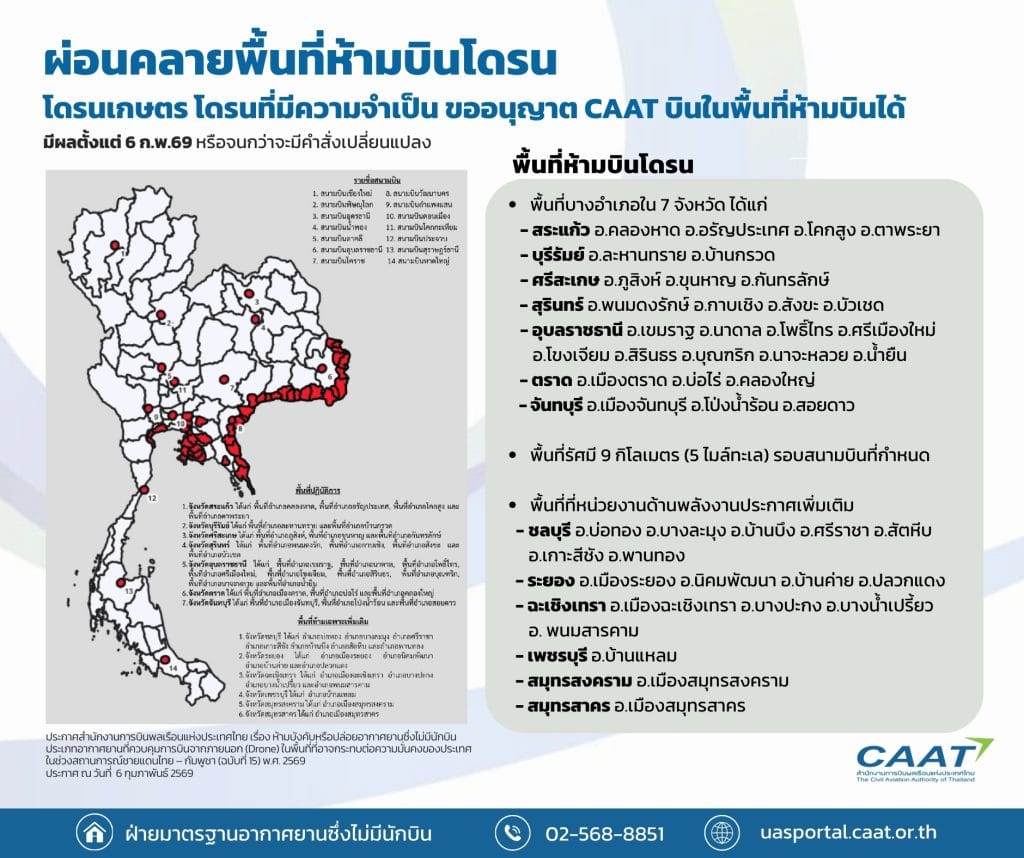
The CAAT has issued Announcement No. 15, relaxing some measures after continuously assessing the situation in collaboration with security agencies. However, it still maintains the "no-fly drone zones" in areas that may affect national security, including certain districts in 7 border provinces between Thailand and Cambodia, areas within a 9-kilometer radius around designated airports, and additional specific areas as announced by energy/security agencies. This is effective from February 6, 2026, until further notice or changes.
The Civil Aviation Authority of Thailand (CAAT) has issued Announcement No. 15 titled "Prohibition on the operation or release of unmanned aircraft (Drones) in areas that may affect national security during the Thailand-Cambodia border situation." This announcement is effective from February 6, 2026, until further notice or changes.
Announcement No. 15 is a relaxation of the drone usage control measures compared to the previous announcement, following the ongoing assessment of the situation in collaboration with security agencies. This aims to allow the public and businesses to carry out activities closer to normal conditions. At the same time, the no-fly zones in areas that may affect national security and critical infrastructure are still maintained, including certain districts in 7 border provinces between Thailand and Cambodia, areas within a 9-kilometer (5 nautical miles) radius around designated airports, and additional specific areas as announced by energy and security agencies.
The CAAT continues to impose strict control measures on drone operations in these areas to maintain security, order, and national stability, while simultaneously relaxing restrictions in general areas where the situation has improved.
No-fly zones according to Announcement No. 15.
1. Areas with the deployment of forces or ground operations at the district level in 7 border provinces between Thailand and Cambodia
(Drone operations are prohibited in the areas specified by security agencies.)
Ubon Ratchathani Province: Khemarat District, Natun District, Pho Sai District, Sri Mueang Mai District, Khong Chiam District, Sirinthorn District, Bunterik District, Na Jaluai District, Nam Yuen District.
Si Sa Ket Province: Phu Sing District, Khun Han District, Kantharalak District.
Surin Province: Phanom Dong Rak District, Kab Choeng District, Sangkhah District, Bua Ched District.
Buri Ram Province: Lahan Sai District, Ban Kruat District.
Sra Kaeo Province: Khlong Hat District, Aranyaprathet District, Kok Sung District, Ta Phaya District.
Chanthaburi Province: Mueang Chanthaburi District, Soi Dao District, Pong Nam Ron District.
Trat Province: Mueang Trat District, Khlong Yai District, Bo Rai District.
Note: Announcement No. 15 changes from the "province-wide ban" in certain areas to a "ban on specific districts with security risks."
Areas within a 9-kilometer (5 nautical miles) radius around designated airports.
No-fly zones within a 9-kilometer radius around designated airports as specified in the announcement include:
Chiang Mai Airport.
Phitsanulok Airport.
Udon Thani Airport.
Nam Phong Airport.
Taklee Airport.
Ubon Ratchathani Airport.
Nakhon Ratchasima Airport (Korat).
Watthana Nakhon Airport.
Kamphaeng Saen Airport.
Don Mueang Airport.
Khok Katian Airport.
Prachuap Khiri Khan Airport.
Surat Thani Airport.
Hat Yai Airport.
3. Areas specifically prohibited by energy and security agencies.
Chonburi Province: Bo Thong District, Bang Lamung District, Ban Bung District, Si Racha District, Sattahip District, Koh Si Chang District, Pan Thong District.
Rayong Province: Mueang Rayong District, Nikom Phatthana District, Ban Khai District, Pluak Daeng District.
Chachoengsao Province: Mueang Chachoengsao District, Bang Pakong District, Bang Nam Prieo District, Phanom Sarakham District.
Phetchaburi Province: Ban Laem District.
Samut Songkhram Province: Mueang Samut Songkhram District.
Samut Sakhon Province: Mueang Samut Sakhon District.
Flight conditions in other areas (outside no-fly zones).
Registration.
Users must register the "drone operator" and the "drone" with the CAAT accurately and completely.
Request permission in advance.
Submit the flight operation permission request at least 3 days in advance through the UAS Portal (uasportal.caat.or.th).
Notify before every flight.
Once permission is granted, you must notify the flight details (area, date, time, purpose) through the UAS Portal.
And notify the Anti-Drone Operations Center (ศบตอ.น.) via email: [email protected] .
Flight operation requirements (according to Announcement No. 15).
Flying is allowed between 06:00 – 18:00.
Strictly prohibited from 00:01 – 04:00, under all circumstances.
If you need to fly between 04:01 – 05:59 or 18:01 – 24:00, you must submit a request for "operations differing from the conditions" to the CAAT through the UAS Portal.
The flight height must not exceed 90 meters (300 feet) above ground level.
If it is necessary to operate a flight that differs from the specified conditions, a special permission request must be submitted to the CAAT through the UAS Portal.
Announcement No. 15 from the Civil Aviation Authority of Thailand (CAAT).
It is effective from February 6, 2026.


Exemptions for government agencies (according to Announcement No. 15):
Unmanned aircraft of government agencies, including military, police, the Customs Department, the Ministry of Agriculture and Cooperatives, the Ministry of Natural Resources and Environment, and the National Intelligence Agency, are allowed to operate according to their official duties.
However, in the case of flight operations in no-fly zones by the Customs Department, the Ministry of Agriculture and Cooperatives, and the Ministry of Natural Resources and Environment, cooperation is requested.
Notify flight operation details in advance through the UAS Portal (uasportal.caat.or.th).
Coordinate with the Anti-Drone Operations Center, Metropolitan Police Bureau (ศบตอ.น.) via email [email protected] and the relevant security agencies in the area before starting flight operations.
To ensure the smooth execution of the mission, in line with security measures, and to avoid impacting the safety of the area.
Channels for reporting tips in case of illegal drone use or potential security threats (according to Announcement No. 15):
If you spot an unmanned aircraft (drone) that violates the announcement or may pose a threat to national security, please report the date, time, location, drone characteristics, and photos or videos (if available) to the responsible authorities promptly through one of the following channels:
1. Civil Aviation Authority of Thailand (CAAT)
Phone: 02-568-8851
Email: [email protected]
2. Anti-Drone Operations Center, Metropolitan Police Bureau (ศบตอ.น.)
Phone: 02-126-7846
Email: [email protected]
3. Local authorities in the area where the incident was spotted.
Local police station.
Military units.
Security agencies responsible for that area.
Summary table of changes (latest version).
| section | Announcement No. 14 (previous version). | Announcement No. 15 (latest version). |
|---|---|---|
| Overall status. | High Strictness Tight control measures in areas with security and energy risks. |
Partially Relaxed General areas revert to basic regulations, but security zones remain in place. |
| Scope of no-fly zones. | A complete no-fly ban for certain areas (e.g., Nakhon Ratchasima) and an expansion of energy/industrial zone restrictions in several provinces. | Changed to no-fly ban in specific districts in 7 border provinces between Thailand and Cambodia. Additional specific areas remain as per the announcement by energy/security agencies. |
| Areas around airports (9 km radius). | Control the 9 km radius around several designated airports. | Unchanged 9 km radius around designated airports for flight safety. |
| Flight time conditions. | Strictly prohibited from 00:01 – 04:00. Early morning/evening flights require special permission. |
Same measures as before 06:00 – 18:00, flying is allowed as usual; 04:01 – 05:59 and 18:01 – 24:00 require special permission. |
| Impact on general users. | General users are significantly impacted by the expansion of no-fly zones in several key economic provinces. |
Users in general areas can carry out activities close to normal. However, strict adherence to regulations is still required in security zones. |
CAAT Announcement No. 15: Relaxing some measures, but maintaining no-fly zones for security purposes.
The CAAT has issued Announcement No. 15 to relax the drone flight control measures for civilians compared to the previous version, following continuous assessments with security agencies. This is to allow the public and businesses to carry out activities closer to normal conditions. At the same time, no-fly zones remain in place in areas that may affect national security and critical infrastructure. The key points are as follows:
No-fly zones (still strictly controlled).
Areas with the deployment of forces or ground operations at the district level in 7 border provinces between Thailand and Cambodia (designated by district).
Areas within a 9-kilometer (5 nautical miles) radius around designated airports.
Additional specific areas as announced by energy and security agencies in Chonburi, Rayong, Chachoengsao, Phetchaburi, Samut Songkhram, and Samut Sakhon provinces.
Differences from the previous version (Announcement No. 14).
Announcement No. 14: Focused on increasing strictness in areas with security risks by expanding energy/industrial zones and certain provinces broadly.
Announcement No. 15: Relaxed measures in general areas and adjusted the no-fly ban from "province-wide" to specific areas/districts with risks to allow public activities and businesses to return to near-normal conditions.
Operational conditions (maintaining core safety measures).
Strictly prohibited from 00:01 – 04:00, under all circumstances.
Normal flight hours: 06:00 – 18:00 (For 04:01 – 05:59 and 18:01 – 24:00, special permission must be requested through the UAS Portal).
Drone operators must register the operator and the drone with CAAT, submit a permission request in advance, and notify flight details before every flight through the UAS Portal, while coordinating with the Anti-Drone Operations Center (ศบตอ.น.) as specified.
Note: This is effective from February 6, 2026, until further notice or changes.
Follow the latest news and inquire for more information: You can stay updated on the Thailand–Cambodia conflict situation and drone technology information at the website: https://droneth.or.th/drone-border-tension/
Or for more information, you can contact via LINE Official: @droneth
